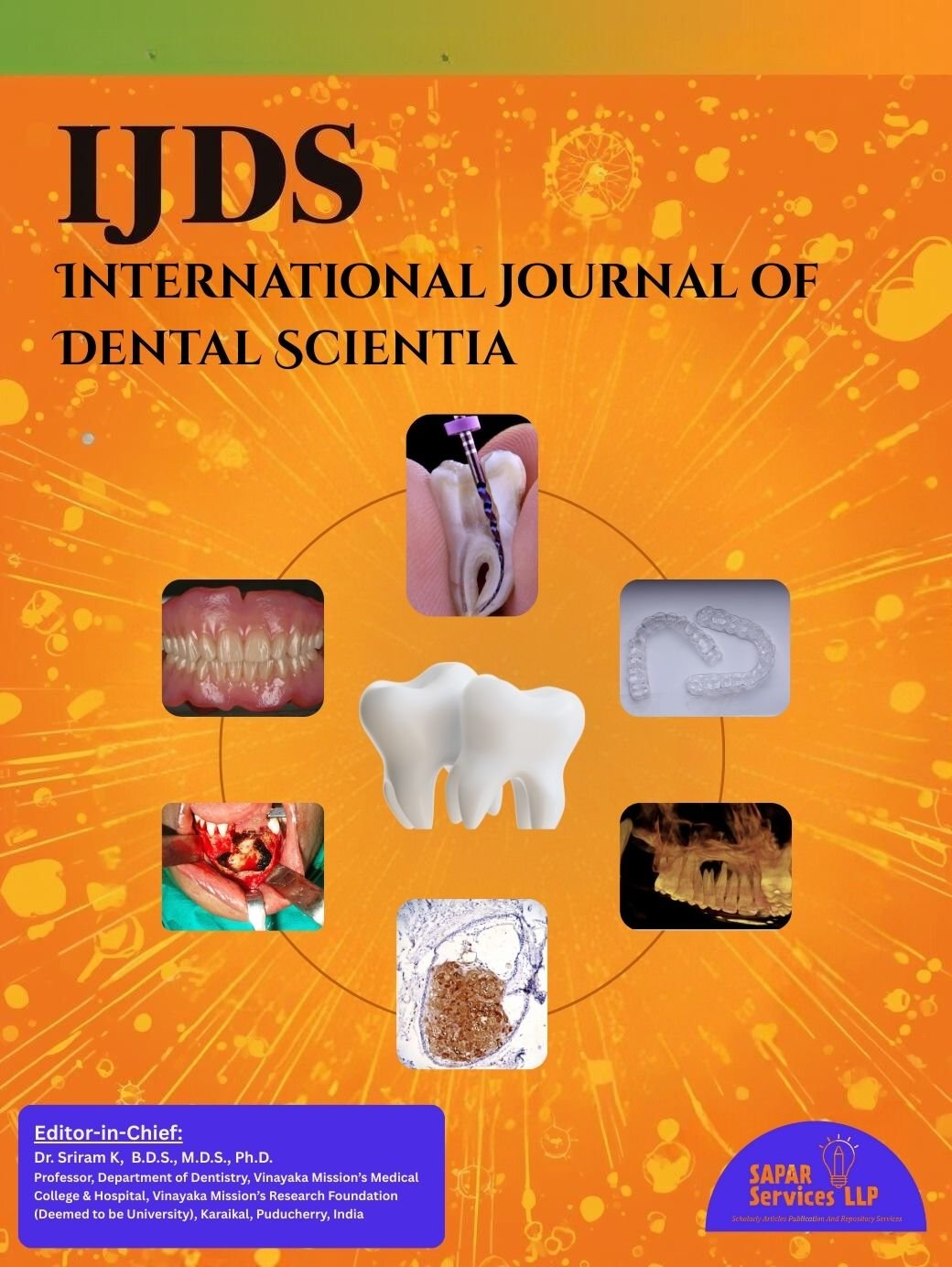
About the Journal
AIMS
The International Journal of Dental Scientia (IJDS) is a peer-reviewed, bi-annaul, open-access journal dedicated to advancing global knowledge in the dental and oral sciences. Our goal is to serve as a platform for high-quality research that bridges the gap between theory and practice in dentistry, leading to better clinical outcomes, informed policy, and improved patient care.
We aim to foster innovation through evidence-based research, while encouraging the integration of diverse methodologies ranging from basic scientific studies to clinical trials, epidemiological research, and qualitative studies. The journal places a strong emphasis on interdisciplinary collaboration, recognizing the interconnectedness of dentistry with general health, biomedical sciences, pharmacology, public health policy, and emerging fields like artificial intelligence.
By publishing original research, systematic reviews, case studies, technological innovations, and policy papers, IJDS aims to:
Disseminate groundbreaking findings that drive dental research and clinical practice forward.
Facilitate collaboration among dental professionals, healthcare providers, and policymakers.
Foster innovations in dental education, technology, and patient-centered care.
Ensure the ethical, responsible dissemination of research that respects patient rights and societal needs.
International Journal of Dental Scientia (IJDS) seeks to be more than just a repository of academic work; it aims to shape the future of oral healthcare worldwide.
SCOPE
The International Journal of Dental Scientia (IJDS) welcomes research across a wide array of topics that reflect the multidisciplinary nature of modern dentistry. We invite contributions in the following thematic areas:
- Clinical Dentistry
Clinical dentistry is the cornerstone of dental practice, addressing both general and specialized care. This section encompasses research in the diagnostic, therapeutic, and restorative aspects of oral health care. The key areas include:
I) General Dentistry
Studies on routine clinical interventions, patient management techniques, and approaches to holistic care that improve treatment outcomes and patient satisfaction. This includes preventive protocols like caries risk assessment, fluoride treatments, and the use of dental sealants.
II) Restorative Dentistry
Research on the latest advances in restorative techniques, such as biomimetic materials, minimally invasive procedures, and adhesive technologies. Emphasis is placed on improving the longevity and esthetic outcomes of restorations through innovative materials and techniques.
III) Periodontics
Investigations into regenerative periodontal treatments, advances in tissue engineering for periodontal regeneration, and the role of the oral microbiome in periodontal health. Research on non-surgical and surgical therapies, such as laser-assisted therapies, is also a focus area.
IV) Endodontics
Advances in root canal therapy, including new instrumentation, irrigation systems, and techniques that enhance the effectiveness and comfort of treatment. Research on regenerative endodontics and tissue engineering in root canal therapy is also encouraged.
V) Prosthodontics
Contributions on implant-supported restorations, the integration of digital workflows in prosthodontic practices, and innovations in esthetic rehabilitation, including veneers, crowns, and dentures. Research on material science, particularly biocompatible and long-lasting prosthetic materials, is key to this specialty.
VI) Orthodontics
Research focusing on advancements in biomechanical studies, clear aligner therapy, and the development of new technologies for craniofacial growth. Studies on digital orthodontics, such as 3D imaging and the use of artificial intelligence for treatment planning, are highly valued.
VII) Pediatric Dentistry
Studies addressing preventive protocols, early intervention strategies, and behavioral management techniques for pediatric patients. Research on the impact of oral health during childhood on long-term health outcomes and preventive measures tailored to specific age groups is encouraged.
VIII) Geriatric Dentistry
Research focused on the unique oral healthcare needs of the aging population, including the management of dry mouth, tooth loss, and systemic diseases that affect oral health. Emphasis is placed on improving the quality of life and autonomy of elderly patients through dental care.
IX) Oral and Maxillofacial Surgery
Research on surgical techniques for trauma, pathology, and reconstructive surgery, including innovations in bone grafting, temporomandibular joint surgery, and cosmetic procedures. This area also covers studies on minimally invasive approaches and advancements in post-surgical care.
- Oral Medicine and Pathology
This section highlights the diagnosis and management of oral diseases, particularly those with systemic implications. Key research areas include oral cancer, salivary biomarkers, genetic predispositions, and the links between oral and systemic diseases, such as cardiovascular and metabolic conditions.
- Dental Materials and Biomaterials
Studies on the development, properties, and clinical applications of dental materials, including composites, ceramics, polymers, and bioactive agents. Research on the integration of these materials into digital workflows (CAD/CAM) and their long-term outcomes in clinical settings.
- Oral and Maxillofacial Radiology
Research on imaging techniques such as Cone-Beam Computed Tomography (CBCT), MRI, and digital radiography. Studies on optimizing radiation exposure, image-guided interventions, and the use of AI for diagnostic accuracy are encouraged.
- Dental Implantology
Implantology continues to evolve, with research on the latest techniques for placement, maintenance, and long-term success of implants. Topics include digital planning, bone regeneration, guided implant surgery, and complications like peri-implantitis.
- 6. Cosmetic and Aesthetic Dentistry
Studies on the latest minimally invasive esthetic procedures, such as veneers, composite restorations, teeth whitening, and digital smile design. Research on the psychosocial impacts of cosmetic dental procedures is also a focus area.
- Public Health Dentistry
Research on community-based oral health programs, policies to reduce oral disease burden, and studies on health disparities across socioeconomic groups. Emphasis is placed on prevention, health promotion, and strategies for global oral health improvement.
- Dental Hygiene and Preventive Care
Studies on the role of dental hygiene in preventing oral diseases, including innovations in hygiene tools, patient education, and behavioral science. Research on preventive protocols tailored to different risk categories and age groups is critical in this section.
- Innovations and Technology in Dentistry
This section highlights the role of digital technologies, AI, and robotics in revolutionizing dental practice. Research on the integration of 3D printing, CAD/CAM, and intraoral scanning technologies to improve precision and patient comfort is a key area of interest.
- Interdisciplinary Approaches in Dentistry
Research exploring the bidirectional relationship between oral health and systemic diseases, such as diabetes, cardiovascular diseases, and respiratory disorders. Studies on collaborative care models involving dentists, physicians, nutritionists, and other health professionals are highly encouraged.
- Research and Development in Dental Sciences
Focusing on pioneering research, including stem cell therapies, novel biomaterials, and drug delivery systems for oral health. Translational research bridging laboratory studies with clinical applications is central to this section.
- Ethics, Law, and Professionalism in Dentistry
Research addressing ethical dilemmas, patient autonomy, informed consent, and legal frameworks in dental practice. Studies on emerging ethical issues, such as AI in diagnostics and digital record-keeping, are of particular interest.
- Education and Training in Dentistry
Research on dental education innovations, competency-based learning, e-learning platforms, and the integration of simulation tools in dental training. This section also focuses on lifelong learning and professional development for dental practitioners.
JOURNAL PARTICULARS
- Title: International Journal of Dental Scientia
- Frequency:biannual
- e-ISSN: ****-****
- Publisher: SAPAR Services LLP
- Chief Editor:
Dr. K. Sriram, B.D.S., M.D.S., Ph.D.
Professor, Department of Dentistry, Vinayaka Mission’s Medical College & Hospital, Vinayaka Mission’s Research Foundation (Deemed to be University), Karaikal, Puducherry, India
Email: sriram2385@vmmckkl.edu.in
Mobile Number: 7550387050, 9597889524 - Copyright: SAPAR Services LLP
- Starting Year: 2026
- Subject: Dental
- Language: English
- Publication Format: Online
- Mobile No:8807410132
- Email Id: scientiarum@sapars.co.in / writetous@sapars.co.in
- Website: www.sapars.in
- Address: 8, Velmurugan Street, Soolai Pallam, MGR Nagar, Chennai - 600078, Tamil Nadu, India